— The Journal / Entry 03 · On number sense
Why digits arrive last.
Foundation Phase number sense isn't about memorising digits. A short note on the order children actually need them in — quantity first, picture second, digit last.
By Chelsi Cryer · 4 min read
A six-year-old who can recite the numbers one to twenty does not, necessarily, know what any of them mean.
This is the first thing I tell parents who arrive worried that their child is "behind in maths." Most of them have been told the child can count. The school has tested counting. The reception teacher has confirmed counting. The grandparent has been thrilled by counting. But counting and number sense are not the same thing — and the gap between them is where most early-Foundation-Phase number difficulties hide.
— 01 / The three layers of a number.
Every number has three layers, and Foundation Phase children need to meet them in a specific order.
The first layer is quantity. Five is five biscuits, five fingers, five knocks at the door. The child who has met five as a quantity knows it is more than three and less than ten — not because they have been told, but because they have lifted three biscuits, then five, then ten, and felt the difference.
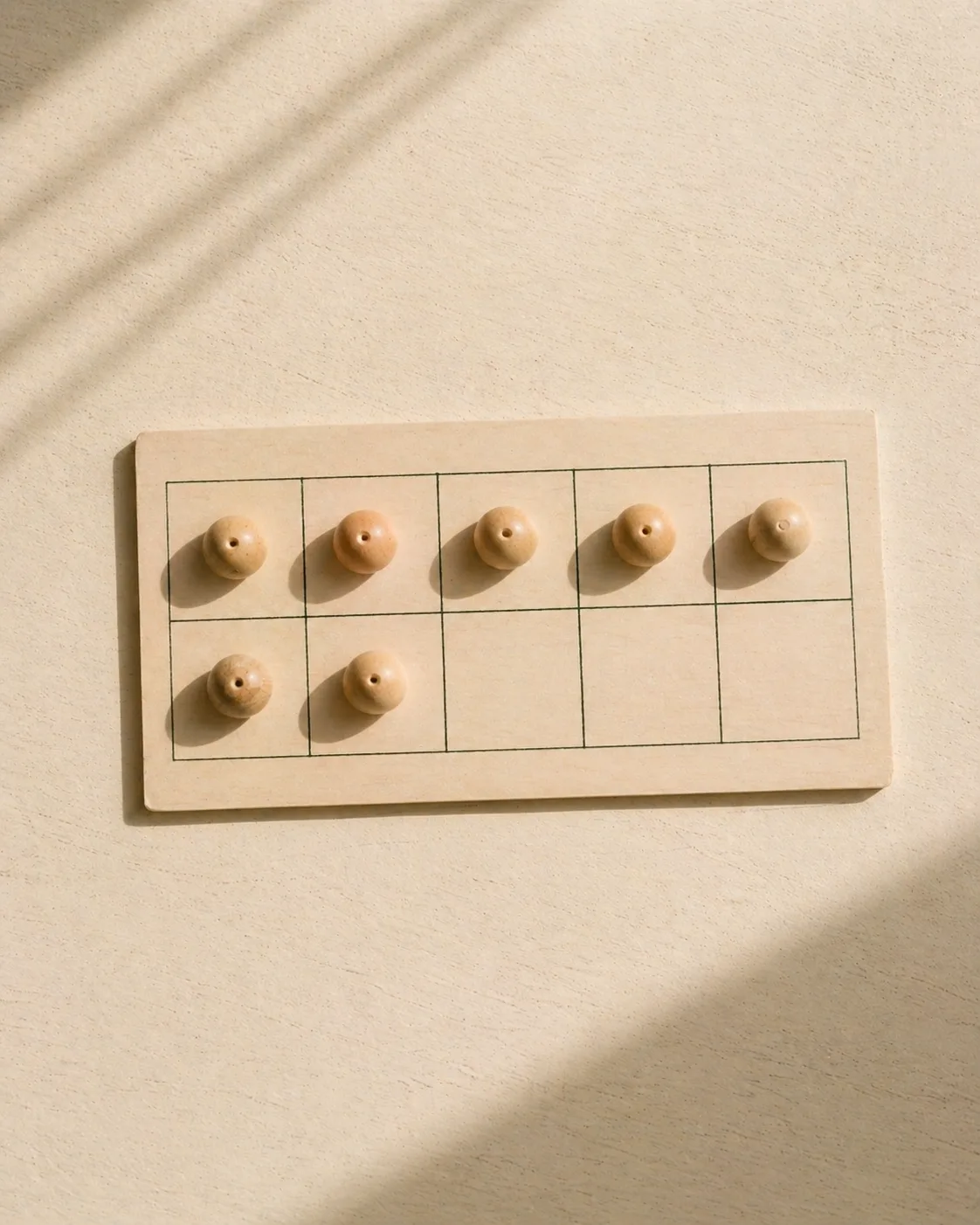
The second layer is picture. Five is the dot pattern on a die. Five is a ten-frame with five filled squares. Five is the shape a hand makes when it shows five fingers. The child who has met five as a picture can recognise it without counting — they have built a stable internal image of the quantity.
The third layer is digit. Five is the symbol "5" on a page.
Most early maths teaching reverses the order. The child meets the digit first — as a flashcard, as a number line, as a poster on the wall — and is asked to learn that "5" goes after "4." This is the equivalent of teaching a child to read by handing them the word "elephant" before they have ever seen one.
— 02 / What the reversal costs.
The cost shows up in Grade 1, not Grade R. A child who has memorised the digits can pass most Grade R counting tasks. They can recite. They can match. They can even, if pressed, count a small set of objects. But by Grade 1 the maths gets harder, and the digits start carrying weight the child has not built.
"Three plus four" is asked, and the child has no way to do it except by counting up — slowly, on fingers, often wrongly. They have never built three. They have never built four. They have certainly never built three-and-four-together. The arithmetic stalls because there is no quantity underneath the symbols.
This is the child who arrives in the practice room in Grade 2 or Grade 3 with what looks like a "maths problem." The maths problem is not a maths problem. The maths problem is that nobody ever filled in the bottom layer.
— 03 / What the right order looks like.
In the practice room, every number from one to twenty gets the same treatment. We meet it as a quantity first — physically, with counters and biscuits and steps. We meet it as a picture next — with dot patterns, ten-frames, finger configurations, and arranged objects. Only after the picture is stable do we introduce the digit, and even then we keep the picture nearby. The number "5" stays paired with the dot-pattern five for weeks.
It looks slow. It is, in fact, exactly fast enough. By the time the child meets "3 + 4" they have built three, they have built four, and they have built the way three and four sit next to each other on a ten-frame. The arithmetic does not stall because there is something underneath it.
The Number Sense Bundle 1–20 in the resource library is this order in print form. Subitise. Compare. Partition. Bond. Digit — last.
Chelsi Cryer is a Foundation Phase remedial teacher in Ballito, KwaZulu-Natal. The practice runs discovery calls.